


Mastering Camera Settings for Digital Photography

Today’s chosen theme is Mastering Camera Settings for Digital Photography. Step into a confident, creative way of shooting as we translate technical controls into intuitive decisions you can make in the field. Subscribe, comment, and share your experiments as you learn.

Aperture as Storytelling

Aperture shapes depth and emotion, from buttery backgrounds at f/1.8 to sweeping clarity at f/11. I once shot a quiet café portrait at f/2, isolating laughter behind glass reflections. Try two versions today and tell us which feels truer.

Shutter Speed as Time Control

Shutter speed decides whether you freeze a bicyclist mid-sprint or blur city lights into neon ribbons. My first long exposure of a waterfall at dusk felt like capturing breath itself. Share your favorite shutter discovery in the comments.

ISO as Sensitivity Strategy

ISO balances brightness and noise. Keep it low for crisp daylight, raise it wisely after sunset. A night street shot at ISO 3200 saved a fleeting smile beneath a lamppost. Test your camera’s noise limits and compare results with our community.

White Balance and Color You Can Trust

Move beyond Auto by dialing Kelvin temperatures. Try 5600K in daylight, 3200K in tungsten rooms, and warm it up at sunset for golden memory tones. Post two versions of one scene and ask readers which feeling they prefer.

White Balance and Color You Can Trust

Use a gray card or neutral surface to teach your camera the scene’s true light. I corrected a candlelit dinner’s orange cast in seconds. Practice this before your next family event and share a before-and-after pair.
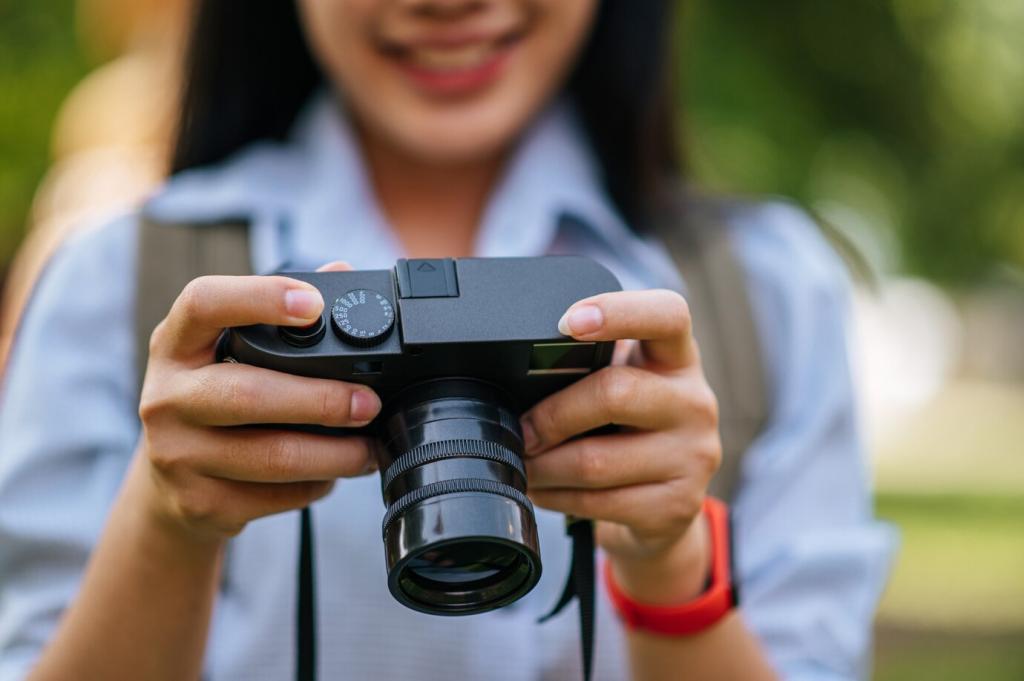

Focus Modes and Autofocus Areas That Nail the Shot

Single focus is perfect for portraits that hold still, continuous for sports and kids, and manual for tricky low light. I rescued a dim jazz club photo by switching to manual. Try each mode today and report your surprises.

Focus Modes and Autofocus Areas That Nail the Shot

Use single-point for accuracy, dynamic zones for erratic movement, and wide tracking for walking subjects. A single AF point on the nearest eye changed my portrait hit-rate overnight. Share your best AF strategy for wildlife or street.

Focus Modes and Autofocus Areas That Nail the Shot

Separating focus from the shutter lets you lock and recompose without refocusing. It felt awkward for a week, then essential forever. Give it seven days and comment whether it transformed your keeper rate as it did mine.

Metering Modes and Exposure Compensation Like a Pro

Evaluative is versatile, center-weighted favors the subject, and spot reads a tiny slice of tone. Spot metering saved a backlit portrait on a blazing beach. Test all three on the same scene and share the results.

Metering Modes and Exposure Compensation Like a Pro

Dial in plus or minus compensation when snow, sand, or night tricks the meter. At a wedding, +1 kept the dress luminous without losing lace detail. Practice bracketing and tell us which compensation value you prefer.

Picture Profiles, RAW, and In‑Camera Processing

RAW preserves maximum data for editing; JPEG gives smaller, ready files. Shooting RAW rescued a sunrise when shadows ran deep. Try RAW+JPEG this week and tell us which version you kept and why.

Sunrise Landscape

Start at f/8–f/11, ISO 100, tripod, and a shutter that fits the light. Expose for highlights to keep sky detail. Share your bracketing results and discuss which frame captured the mood best.

Fast Action Sports

Use shutter priority around 1/1000s, Auto ISO with a cap, and continuous AF with tracking. Anticipate peak motion and pan smoothly. Post your settings and a frame where timing made the decisive difference.

Indoor Low Light Moments

Open aperture, stabilize your stance, and raise ISO thoughtfully. Switch to manual or spot meter faces, not the room. Share two edits—one noise-reduced, one detailed—and ask for community preferences.
Tirinavoxolaron
Privacy Overview

This website uses cookies so that we can provide you with the best user experience possible. Cookie information is stored in your browser and performs functions such as recognising you when you return to our website and helping our team to understand which sections of the website you find most interesting and useful.